


Can I Actually Do This? Every Dad's Question

.svg)


by Ken Canfield, Ph.D.
Something happens to a man when he becomes a father.
At some point, the weight of his role stops feeling like a routine and starts feeling like something else. Something bigger. Something spiritual. Something he isn’t sure he’s ready for.
Most men feel that and don’t quite know what to do with it. J.D. Vance put it into words — and what he said goes way beyond politics.
Vance has never hidden his story. He grew up with his grandmother as his anchor; his biological father was absent, and a series of stepfathers came and went. So he knew what he didn't want to repeat when he became a father in 2017. In his recent memoir Communion: Finding My Way Back to Faith, he describes those first hours after his son Ewan was born — how the gravity of the moment brought him to his knees and he prayed for hours, asking God to help him be a good dad.
What he didn't yet know was how to become the father his son would need. In the book, he puts the central question into words: “How to inculcate virtue in a person is the most important question I confront with my son.” That question eventually led him to the Catholic Church — a spiritual foundation he could build a family on.
We've heard versions of that same story from everyday heroes — men who feel that deep sense of purpose as dads but will never make the headlines.
When Fatherhood Finds You
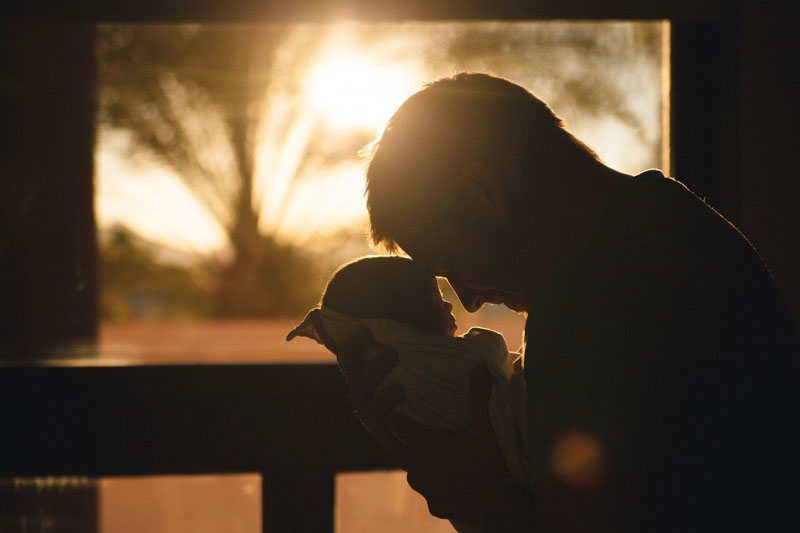
For many dads, it will happen in the delivery room. A man holds his newborn for the first time and everything else feels suddenly beside the point. The competence he's built up at work doesn't apply here, and neither does the image he's spent years maintaining. And what he's left with, along with all the joy, is a plain truth: he's standing at the beginning of one of the most important things he'll ever do, and he's going to need help that is beyond him.
It’s a huge moment, and I’d encourage every new dad not to rush past it or let it get buried under the noise of the days that follow. God may be whispering in your ear louder than normal in that room: this child needs you to become someone worth following.
But those whispers don't stop at the hospital. They show up again when a son makes the same mistake you made at his age. Or when a daughter goes quiet and you don’t know why. When an ordinary moment — a drive home, a walk, holding a small hand — catches you off guard and you realize you haven't been as present as this fathering role deserves.
The wake-up call takes different forms: maybe a crisis, or a run of success at work that makes you wonder if you're chasing the right things, or an entirely unremarkable Tuesday that somehow changes everything. Nobody schedules their eye-opening moment.
The Deeper Question
The surface question is: Can I actually do this? But Vance brings up a harder one, and it isn't about being involved in your child's life or whether you raised your voice last week. The real question is:
What are you really passing on to your children, and is it what you intend?
It's about how a child's character gets shaped — how virtues move from one generation to the next, or don’t.
In our research, one of the defining factors that separates effective fathers from everyday dads is spiritual equipping — a father's willingness to take his children's spiritual lives as seriously as their physical or academic lives. A child can no more opt out of spiritual development than he can opt out of being human. So the question was never whether your children will develop spiritually; it's how well or how poorly, and whether you're paying attention to that part of their lives.
Spiritual equipping doesn't get much airtime in our culture, and many dads are relieved. It sometimes feels like territory that belongs to someone more qualified: the pastor, the youth leader, anyone but the man at the dinner table. But the research is clear, and so are the moments fatherhood puts in front of you, if you slow down long enough to recognize them — the delivery room, the ordinary Tuesday, the quiet realization that you've been missing something. Those questions about virtue, about faith, about what you're actually passing on — those are fatherhood questions. They belong to you.
Things Can Be Different
Vance's prayer over his son was a defining moment for him. Over the years, we’ve seen similar stories where men grew up without a good model of fatherhood and still became genuinely good dads. They held their child and thought: things can be different between you and me.
The ones who followed through didn't have it all figured out, but they were more intentional. They were clear-eyed about what they were passing on, stayed honest with themselves, and kept going even when progress seemed slow.
Your children don't need you to be perfect; they need you to pay attention — to them, to yourself, to the moments fatherhood keeps bringing your way.
Those moments will keep coming. How will you respond?
Questions to Consider
Think back to the moment fatherhood first hit you with its full weight — in the delivery room or somewhere else. What did that feel like, and what did you do with it?
Vance says the most important question he faces as a father is how to shape virtue in his son. How are you addressing that question in your own home — not in theory, but day to day?
Our research found that spiritual equipping was linked to fathering effectiveness. What does that stir up in you?
Is there something you grew up without that you’re determined to give your children? What are you actually doing to make that happen?
What would it look like this week to pay closer attention — not to fix something, but just to notice what fatherhood might be asking of you right now?

.svg)

.svg)


